Amsterdam is one of those cities that do not suffer from a scarcity of revolutionaries whose revolutionary zeal is sufficient only to revolt against… traffic rules and basic norms of human decency. People around me are often taken aback by the passion with which I engage with them. “Why do you get so riled up against anti-social behavior on the street? Isn’t that just normal by now? Just come to terms with it and move on”, I get told. I can’t, unfortunately. There are a few key moments of realization, some personal and some scientific, in my life that can shed light on why.
My conflict with motorists first started when I was in high school about 15 years ago. Being from what used to be a beautiful, human-scale Soviet city with mostly 5-story tall apartment buildings, I had the freedom and luxury of being able to walk back home alone from school as a teenager, instead of being delivered as a FedEx package. This was one of the most blissful moments of my life back then as the road back home was mostly on an almost uninterrupted, ungodly wide, and nicely paved sidewalk where you could run sideways without ever reaching the car road. The trees planted on both sides of the sidewalk provided lots of shade and the distance was long enough to give me some physical activity and mental space after a long day at school but not so long to exhaust me. The dense urban backdrop made it safe for a kid to walk on these streets as it provided lots of eyes on the street.
These blissful moments of walking back home invariably came to a sudden halt about 200 m away from our apartment, at a T-junction, where I had to cross the road at a zebra. The cars coming from behind had green lights always on to let them turn right. Here is what it looked like:
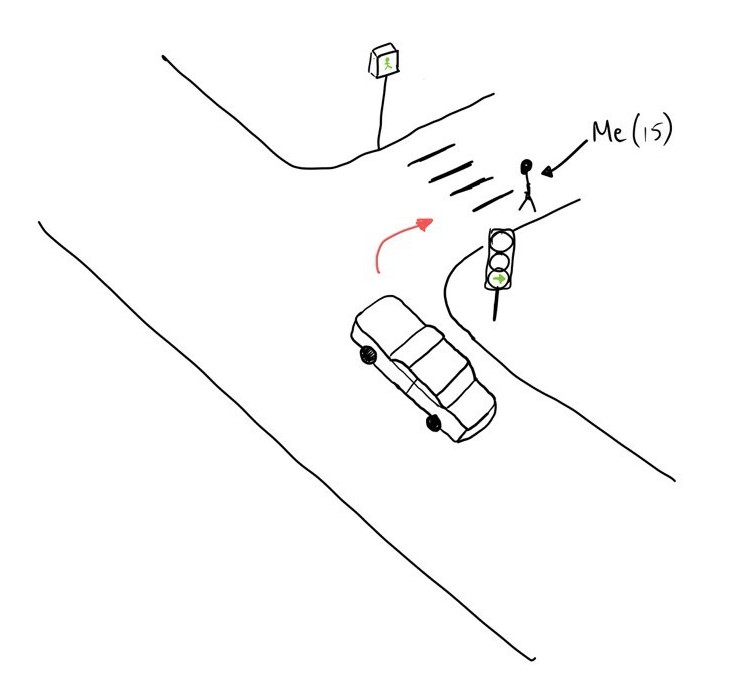
I would wait for the pedestrian light to turn green to cross the road but the cars turning right, if there was one, would not respect my right of way, on several occasions coming dangerously close to hitting me. Unlike most of my peers, I actually waited for the green light, instead of throwing myself at the mercy of motorists, not because I was superior in my cognitive development, but out of pure self-preservation: I don’t think I could’ve survived these repeated trips otherwise. But this experience of witnessing grown-ups behaving in utterly careless, childish, and deeply disturbing ways introduced me to the idea that the physical context, the material base of our reality, over and above our purported beliefs about ourselves, has the most powerful effect on the decisions we make. Those motorists (at least some of them) who harassed me when I pointed it out to them that they did not have priority in this situation were probably loving fathers, husbands, and whatevers at home. How could a loving father put a child into such a danger and then have the boldness to pick a fight with him? In a way, after 15 years, I am still trying to find an answer to this question.
Skip ahead 6 years. I am a master’s student studying behavioral neuroscience in Amsterdam. I live in one of the container houses next to Bijlmerbajes. Looking back, Spaklerweg was not that far away from where I needed to be most of the time, but somehow at the time the road back home from the center felt like an eternity (partly because I guess podcasts have not been invented yet). So I did what any reasonable Amsterdam cyclist does to make my commute shorter, I got a second-hand racing bike that allowed me to blow through the streets like the wind. I had a taste of racing bikes back in Montreal in my bachelor days, but that period tragically came to an end when my bike was stolen from in front of my apartment. Amsterdam’s wide, smooth bicycle roads (not lanes, roads) were nothing like the comically narrow paint job that they called cycling infrastructure in Montreal, they meant freedom! It’s hard to explain how intoxicating it can be to be cruising in a city like Amsterdam on a bike on a gloriously sunny summer day (but you can check out this YouTube channel that gets close).
It was on one such day that I found myself stuck behind a middle-aged man on a typical omafiets (grandma bike). He had his headphones on and would not respond to my repeated ringing from behind. Despite the width of the road which can allow three cyclists to go side by side (if they have to), this guy occupied the whole road not letting anyone overtake him. After about 100m of this interaction, he eventually realized he was on the way and moved to the right side of the road. But he was a bit too late, I was already set on giving him a lesson on traffic rules. And my brilliant idea was to overtake him and cross him a bit more suddenly than he expected to. I did not intend to do him any physical harm, I just wanted to surprise him a little bit to get him out of his bubble and start noticing the ones around him, because we are all busy people and have places to go. Unfortunately, that lesson did not go well, I crossed him way too early and my hind wheel touched his front wheel. As a result, he lost control of his bike. I heard a loud noise from behind, and in my rage, I caught myself thinking for a solid few seconds “Yeah, that’s right, that’ll teach you a lesson”. I heard my mind hold that thought for a couple of seconds… To understand why that’s a life-changing moment for me, you need to keep in mind that the last time I had something remotely resembling a fight was when I was 6-7 years old. I am deeply aversive to physical confrontation and have gone out of my way to avoid such situations my whole life. And yet, here I was, a monster who relished the misfortune of a guy whose sole mistake was to be in front of me for about 100m.
I eventually brought myself back to reality and went back to pick him up. I ended up taking the man to the nearby emergency room where we learned that he damaged his pinky finger in the fall, but nothing serious had happened. We parted ways on friendly terms and I am grateful to that man for being more understanding and forgiving than I would be in a similar situation. I went back to this moment many times in the years that followed: what if he did not fall properly? He could have been injured much more seriously. Who knows maybe he could have died from that accident. What had I been thinking going that fast? I was not even in a rush to somewhere, I was just going back home! I casually took a gamble that could have ended someone’s life.
People all over the world, completely normal, sane people, loving fathers, and mothers, take this gamble every day. An incredible number of them end up in a worse place than I did that day. Every day hundreds if not thousands of people and other animals are killed on the roads globally. We have been taught from earlier on that these events must be called “accidents” and should be considered as a small cost of having the convenience of these vehicles that bring us places at super-human speeds. But are they really just “accidents”?
Accident implies lack of intent and herein lies the devil. The guy who punches you in the face clearly intends to hurt you. But the guy who knows that pressing that gas pedal hard enough will significantly increase his likelihood of killing you is not intending to do so. I contend that the difference between the former and the latter is not as great as we would like to think: the mechanical device that you regulate is mediating your intentions, it does not have its own. In fact, inserting intermediaries between your choices and final outcomes is a classic way of reducing the amount of intent (and hence, responsibility) that can be ascribed to you. In the context of organizations, those in the higher echelons usually use this move when shit hits the fan to get themselves out of the situation. Of course, we don’t always buy it, but when it comes to cars, we almost always do. “So you didn’t mean to kill the man by speeding like an insane person in the middle of the city? Oh okay, then here is your driving license, you can go back to driving again” is roughly what we tell them in most cases. I don’t think we should pardon people just because they had the extra cash to bulldoze people instead of punching them to death. But let me be clear, I also don’t think we should lock up everyone who gets involved in such an event. What’s the right way to approach this then?
The path ahead lies in understanding the basis of decisions made in urban, traffic environments. For a long time, we treated individuals as a unit of decision, the mind as a black box that receives input (visual, in this case), and then decides to act upon it (some say, even rationally). This simple scheme where input-output is nicely delineated from the decision-making, allows us to lock up people who we think did a poor job of making decisions: their black boxes are faulty, so we need to isolate them to make sure those black boxes do not hurt anyone else. In reality, most of our decisions are not made in such clearly delineated, static, rational, categorical ways. We find ourselves immersed in a sea of sensory input where we navigate left and right at every single moment. The result of our actions at time t feed back to the sensory input which in turn changes the action at time t+1 and so on. Most decisions we make as we move through our cities are of this type: continuous, dynamic, unconscious. Our actions happen in the context of our concrete physical bodies being present in concrete physical environments. For instance, we do certain things and not others just because they are easier in that situation, less energetically or cognitively costly. I don’t believe there is anyone in this world who did not ask someone else to pass that cup there, one meter away, just because they were too lazy to reach out to grab it themselves. The same people would never think of asking someone else to do the same when they are standing next to the cup. In short, the environment presents us with a rich landscape of affordances that we choose from, most of the time, without ever thinking of them.
Going back to my “accident”, I lied to you, I never “decided” to give the man a lesson. That’s the kind of term we like to think about and talk about because we rationalize the world through crisp concepts like individual, intent, decision, and action, but the reality is fuzzier in many interesting ways. I just did what I did without thinking and most of what we call “accidents” happen this way. I believe our environments are built without proper appreciation of how deeply they shape our decisions on a moment-by-moment basis. We build wide roads and assume that if we place some numbers on the side people will see the number, weigh the cost and benefit of following the rules, and ultimately decide to comply with the rules. And yet, that is not what people do when they ride a car or a bike. And you know why that is the case because you too know that most drivers treat speed limits as minimum rather than maximum. They go as fast as the environment allows them to go, and refer to the number on the side every now and then to slow down.
My interest in this whole business is in understanding how different aspects of the environment bias us in our decisions as we navigate our world. A lot of my thinking is influenced by works like The Death and Life of Great American Cities by Jane Jacobs, ecological psychology as developed by James J. Gibson, and other thinkers who followed their paths in highlighting the importance of understanding the interface between the human body and the environment. However, unlike Gibson or Jacobs back in the 20th century, we can study behavior quantitatively at a very fine-grained level, model physical agents in space, and use virtual reality systems to play around with the possibilities in the sensory world.
Further readings
- Theeuwes, J. (2021). Self-explaining roads: What does visual cognition tell us about designing safer roads?. Cognitive research: principles and implications, 6(1), 15.
- Transportation Research Part F: Traffic Psychology and Behaviour